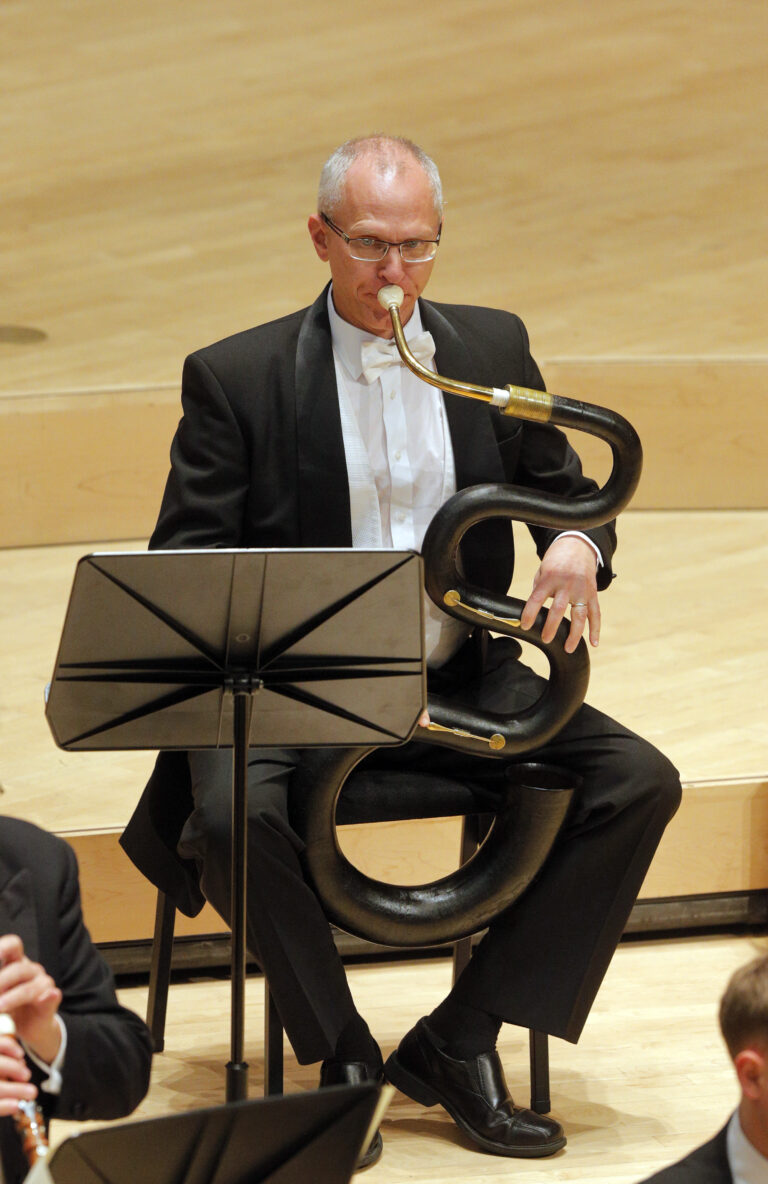
Thomas Carroll’s first Philharmonia concert was supposed to be in October 2020, but was postponed due to COVID-19 until October 2021.
In his words, “I think music was always part of me, but I didn’t realize it until much later. When I was a toddler the “off limits” area in the house was around my mom’s upright piano. She didn’t play a lot, but I used to sit underneath it and listen to her and the sound the instrument could make. My favorite parts of preschool and elementary school were always “music time” followed closely by science, so I’m incredibly fortunate I get to combine those two things in my career as an adult. I started clarinet in fourth grade, played almost all the woodwinds and brass in high school to fill in for ensembles that didn’t have enough of a particular instrument, and sometime between eighth and ninth grade, I realized that I couldn’t really see myself doing anything else that would be as rewarding. So I worked to make it happen.”
Thomas knows the exact moment he was drawn to historical performance:
“It was May 2002 when I was getting ready to perform my very first Mozart Clarinet Concerto as a teenager. I went through a phase of going to Tower Records and buying every recording of the concerto I could find to try to figure out what made all of those performers and their interpretations so unique and inevitably I would end up playing along with the recordings. I bought a boxed set of Wind Concertos from The Academy of Ancient Music with Hogwood and Tony Pay and it sounded different and I couldn’t figure out why I couldn’t play in tune with the CD and why it sounded so much more vibrant and alive than a lot of the recordings I’d already heard. Of course I looked in the booklet and saw the photo of the instrument Daniel Bangham had built for Tony and my mind was totally blown. It looked and sounded so different. Fast forward to my time as an undergrad at Oberlin, and I spent a good chunk of my free time in the library reading treatises and even more time in my dorm room teaching myself to repair and play on these instruments. When I had the opportunity to use the Oberlin Winter Term to do self guided study in historical clarinet (which involved traveling to meet different teachers and absorb everything I could), I jumped at the chance. I went to Indiana University to study with Eric Hoeprich and then followed him to The Hague for another few years before settling back in the US to make things happen over here. I’ve always appreciated how affirming and liberating the HiP movement is at its core, and how easy it is to discover new things, even with works I’ve probably played close to a hundred times. And of course the people are some of the most interesting in the business, so many different life experiences that draw them into this world.”
Tell us about a favorite guest artist from your time with Philharmonia and what you enjoyed most about working with them.
Working with Shunske Sato (October 2021, April 2024) definitely stands out for me. He’s an absolute master of internal rubato and stretching the phrases in such a natural and elastic way. That’s been something I’ve been trying to incorporate into my playing for years, and it’s been so amazing to listen to his performances and hear his thought process in real time. He’s also a whole lot of fun to hang out with after performances, lots of great memories, especially from his last set of performances of the Mendelssohn Violin Concerto.
When did you acquire your current instrument and what are some of its unique characteristics?
I actually build most of the clarinets I perform on. I started building instruments while I was a masters student at Indiana University and kept going. These days, all the baroque and classical instruments I play on are ones that I’ve made myself based on careful measurements of surviving originals. I actually own a rather decent collection of 19th century originals that I use in performance for music from Berlioz onward, and I have a rather unique matched set of Ottensteiner clarinets from Munich, the same maker who made instruments for Brahms’ clarinetist. I’m also extremely fortunate to own the 1900 Mollenhauer bass clarinet that Louis Klein ended up playing under Toscanini in the NBC symphony, but I rarely get to use that one in performances, unfortunately. I’ve also had to make mouthpieces for each of these instruments. It’s a lot of work to build all of these instruments AND make sure I can play all of them equally well, but it’s a lot of fun!
What would you tell a first-time audience member to look for / listen for at a Philharmonia concert?
As a woodwind player, I’d say the first thing a first-time audience member should do is take a look at the woodwinds. We all have instruments with fewer keys than the modern instruments and as a result our fingers have to do a lot more acrobatics to accomplish the same result. You might also see us switching instruments a whole lot more (in February 2023 the clarinets used 4 clarinets each for one concert!). Then I would say listen to the horns, there’s absolutely nothing like the sound of natural horns. Lastly, I’d say listen for the transparency in the string section. The instruments might look the same, but the way they’re set up and the way the bows and gut strings work together creates such a wide variety of colors. It’s like painting with the most accurate paintbrush.
What is the first album you ever bought or connected with?
I think it would probably be the 1987 Pacific Symphony recording of the 13 instrument version of Appalachian Spring. I bought it after music camp the summer after my freshman year of high school and I’m not entirely sure why, but I think that’s the recording that made me realize I wanted to do this as a career.