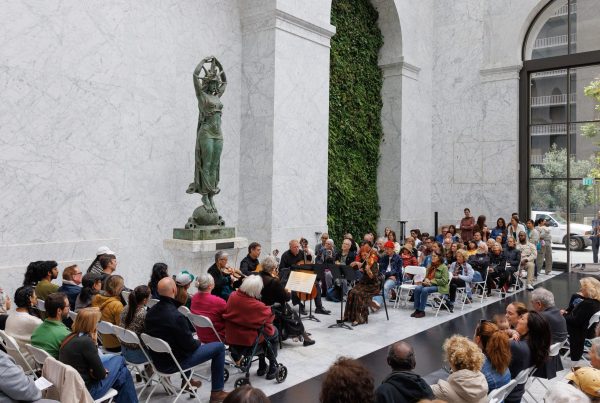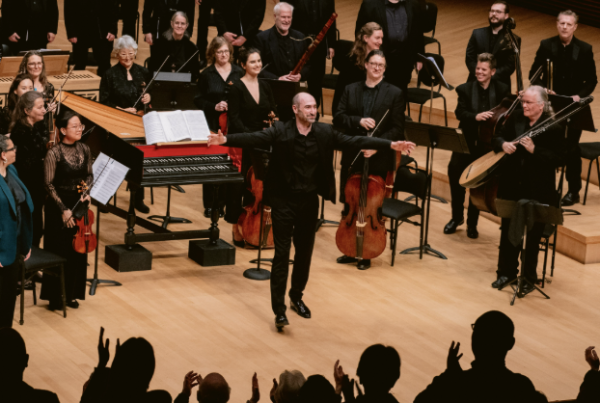
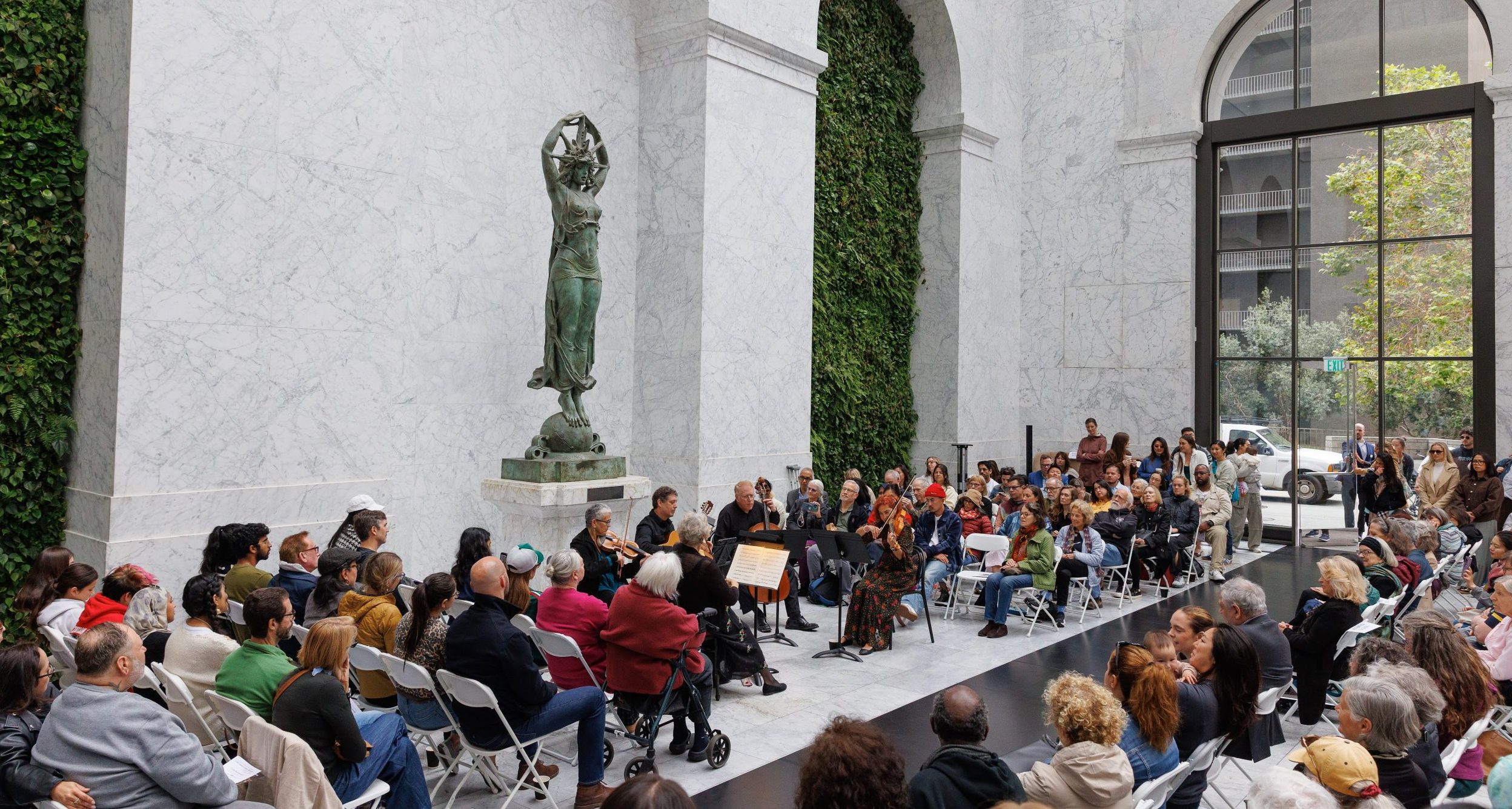
Our Coffee Concert series features members of Philharmonia Baroque Orchestra & Chorale performing on period instruments and in the style of the time, for a listening experience close to what audiences might have heard in the 18th-century salons and coffeehouses of Europe. Enjoy the music—and your coffee!
☕ Your Bite-Sized Program Notes
Claudio Monteverdi – “Cantate Domino”
Monteverdi helped usher music from the Renaissance into the Baroque, bringing a new sense of drama and expression to sacred music. His “Cantate Domino” sets the joyful call to “sing to the Lord” with lively rhythms and bright vocal writing, showing how even sacred music could have the energy of a celebration.
Heinrich Schütz – “Cantate Domino”
Schütz was one of the most important German composers of the early Baroque, and his music reflects both German traditions and the expressive style he encountered in Italy. His “Cantate Domino” turns the same joyful text into music full of contrast, movement, and vivid vocal lines.
Henry Purcell – “Sound the Trumpet” from Come, Ye Sons of Art
Written to celebrate the birthday of Queen Mary II, Purcell’s Come, Ye Sons of Art is music made for ceremony and celebration. “Sound the Trumpet” pairs two voices in a lively musical conversation, creating the effect of trumpets without needing an actual trumpet section. It is bright, festive, and unmistakably regal.
Orlando di Lasso – “Bonjour mon coeur”
Lasso was one of the great musical figures of the Renaissance, equally at home writing sacred and secular music. “Bonjour mon coeur” is a tender French chanson, a musical greeting to a beloved that captures the warmth and intimacy of Renaissance love poetry.
Orlando di Lasso – “Susanne un jour”
“Susanne un jour” tells the story of Susanna from the Book of Daniel, who refuses the advances of two men and is falsely accused by them. Lasso turns the dramatic story into an elegant chanson, balancing the beauty of the music with the tension of its subject.
Orlando di Lasso – “O vin en vigne”
With “O vin en vigne,” Lasso turns from romance and biblical drama to the pleasures of wine. The playful chanson celebrates the grape and the wine it becomes, showing the lighter, more convivial side of Renaissance music.
George Frideric Handel – “Oh, the Pleasure of the Plains!” from Acis and Galatea
Handel’s Acis and Galatea tells a pastoral love story set among shepherds, nymphs, and gods. In “Oh, the Pleasure of the Plains!,” the natural world becomes part of the celebration, with sparkling vocal lines that capture the carefree pleasures of life in the countryside.
Henry Purcell – “See Nature Rejoicing” from Come, Ye Sons of Art
Purcell returns to Come, Ye Sons of Art with music that imagines nature itself joining the celebration. The piece combines graceful vocal writing with a festive spirit, turning the natural world into a musical chorus of congratulations.
Claudio Monteverdi – “Laudate Dominum”
Monteverdi’s sacred music combines the grandeur of the new Baroque style with the expressive power of the human voice. In “Laudate Dominum,” a simple call to praise becomes an opportunity for rich vocal interplay, moving between moments of intimacy and celebration.
Ola Gjeilo – “Ubi caritas”
Written more than three centuries after the Renaissance and Baroque works on today’s program, Gjeilo’s “Ubi caritas” offers a modern take on an ancient sacred text. Its gentle harmonies and flowing vocal lines create a sense of stillness and warmth, reminding us how enduring this text has been across centuries of music.
Johann Sebastian Bach – “Jesus bleibet meine Freude” from Cantata No. 147
Often known in English as “Jesu, Joy of Man’s Desiring,” this beloved movement comes from Bach’s Cantata No. 147. The melody unfolds with a calm, steady grace, while the voices and instruments move together with a sense of quiet devotion. It is music that feels both deeply personal and universally familiar.
Johann Sebastian Bach – “Sicut locutus est” from Magnificat
Bach’s Magnificat was written for Christmas Day in Leipzig and sets Mary’s song of praise from the Gospel of Luke. “Sicut locutus est” looks back to God’s promises to Abraham and his descendants, building the music gradually toward a powerful expression of faith and fulfillment.
George Frideric Handel – “Awake the Trumpet’s Lofty Sound” from Samson
Handel’s Samson draws on the biblical story of the Israelite hero who regains his strength and defeats his enemies. “Awake the Trumpet’s Lofty Sound” is a triumphant call to celebration, with Handel using brilliant vocal writing and a grand orchestral sound to evoke the ringing of trumpets.
George Frideric Handel – “See, the Conqu’ring Hero Comes” from Judas Maccabaeus
One of Handel’s most recognizable melodies, “See, the Conqu’ring Hero Comes” celebrates the return of the victorious Judas Maccabaeus. Its stately rhythm and memorable melody give the music an unmistakably ceremonial character. It became so popular that Handel later incorporated it into other works.
George Frideric Handel – “Swell the Full Chorus” from Solomon
Handel’s Solomon explores the legendary wisdom and reign of the biblical king. “Swell the Full Chorus” brings the oratorio to a grand conclusion, gathering voices and instruments into a final burst of celebration. After the intimacy and variety of the earlier music, it sends the program out on a joyful, expansive note.
🎻 About Today’s Performers
Valérie Sainte-Agathe, conductor
Valérie Sainte-Agathe, a native of Martinique, is the Chorale Director of Philharmonia Baroque Orchestra & Chorale.
Internationally acclaimed for her precision, artistry, and bold programming, Valérie Sainte-Agathe has emerged as one of today’s most compelling chorus masters and conductors. Celebrated for her interpretive depth and creative leadership across symphonic, operatic, and contemporary repertoire, she brings an exceptional blend of musicianship, vision, and collaborative expertise to every ensemble she leads.
Since 2022, Sainte-Agathe has served as Chorale Director of Philharmonia Baroque Orchestra & Chorale, preparing the professional ensemble for conductors Richard Egarr, John Butt, Ruben Valenzuela, Nicholas McGegan, and Peter Whelan. In December 2025, she will make her conducting debut with the orchestra in a landmark program featuring Vivaldi’s Gloria, the world premiere of Roderick Williams’s Quem Pastores Laudavere, and the U.S. premiere of Caroline Shaw’s The Holdfast—a reflection of her artistry at the intersection of historical performance and contemporary innovation.
Sainte-Agathe has been invited by the San Francisco Symphony to prepare works by Brahms under Maestra Nathalie Stutzmann, and will collaborate with the New Century Chamber Orchestra on new works by Nico Muhly and David Conte. Guest conducting engagements include Oakland Symphony chorus, Volti, the Kronos Quartet, and the Philip Glass Ensemble, with appearances at Carnegie Hall, the Barbican Centre, Lincoln Center, and the Kennedy Center.
As Artistic Director of the San Francisco Girls Chorus since 2013, she has commissioned over thirty new works and led collaborations with the San Francisco Symphony, SF Opera, Chanticleer, and Opera Parallèle. In 2024, she was named Chevalière des Arts et des Lettres by the French Minister of Culture.
Victoria Fraser, soprano
Born and raised in Anchorage, Alaska, soprano Victoria Fraser studied music at Smith College, graduating Phi Beta Kappa with High Departmental Honors. Her Master’s in Vocal Performance from the San Francisco Conservatory of Music is complimented by a Master’s in Sacred Music from University of Notre Dame where she studied with Kiera Duffy.
A specialist in music from the middle ages through the late Baroque era, Victoria has performed as a soloist and chorister in Europe and North America, notably with: Il Coro del Duomo in Florence, Italy; the Vocal ensemble Frankfurt Dom, in Frankfurt, Germany; Vox Humana in Dallas, Texas; Grammy-nominated True Concord in Tucson, Arizona; the Berwick Chamber Chorus at the Oregon Bach Festival; American Bach Soloists Academy in San Francisco; and the Bachkantaten-Akademie in Thuringia, Germany. She has sung under the direction of Masaaki Suzuki, Helmut Rilling, Matthew Halls, Craig Hella Johnson, Jeffrey Thomas and Kathy Romey.
Victoria will appear as a featured soloist on 10-time Grammy winning Jazz trumpeter Arturo Sandoval’s upcoming album, to be released this Christmas. As a personal passion, Victoria has recently produced and starred in numerous interdisciplinary arts projects, including Pergolesi’s Stabat Mater with Jessica Lang Dance, and Buxtehude’s Membra Jesu Nostri. Victoria will soon move to Ireland to study Gregorian Chant with scholars from Cambridge and the Sorbonne. A certified PADI Dive Master, Victoria is also passionate about her many outdoor hobbies: rock climbing, downhill skiing, mountain biking, and hiking with her standard poodle, Diva.
Julia Grizzell, soprano
Soprano Julia Grizzell’s coloratura sparkles in repertoire ranging from baroque to contemporary. Most recently she performed the role of Second Woman in Dido and Aeneas with Philharmonia Baroque Orchestra and Chorale, the title role in Verdi’s Luisa Miller with Verismo Opera, and Cleopatra in Giulio Cesare in Egitto with the Handel Opera Academy in Tarnowskie Góry, Poland.
Julia is an avid concert soloist. She has performed the soprano solo in Vivaldi’s Gloria (Philharmonia Baroque Orchestra and Chorale), and Beethoven’s Symphony No. 9, Orff’s Carmina Burana and Haydn’s Lord Nelson Mass, all with the Sequoia Symphony Orchestra. Other solo performances include Rutter’s Magnificat and Requiem, and Mozart’s Requiem and Coronation Mass in C minor, which she sang throughout Italy, Prague, and Budapest with the Biola University Chorale.
Ensemble performances include The Abduction from the Seraglio with Opera San José, the rarely performed Massenet opera Le Cid with Odyssey Opera in Boston, Berlioz’ La Damnation de Faust, Falla’s La Vida Breve, and the world premiere of John Harbison’s Koussevitsky Said at the Tanglewood Music Festival, as well as Mendelssohn’s A Midsummer Night’s Dream with the Boston Symphony Orchestra, Brahms’ Requiem with the Boston Youth Symphony Orchestra, and Bach’s St. John Passion with the Back Bay Chorale at Harvard University.
Julia holds a Master of Music degree from Florida State University, and a Bachelor of Music degree from Biola Conservatory of Music. She also studied at the American Institute of Musical Studies in Graz, Austria.
Shauna Fallihee, alto
Shauna Fallihee has been featured with numerous Bay Area ensembles including San Francisco Choral Society, Philharmonia Baroque Orchestra & Chorale, Masterworks Chorale, San Francisco Composers Chamber Orchestra, Open Opera, West Bay Opera and the Old St. Mary’s Cathedral Noontime Concert Series. Deeply dedicated to the performance of new music, Shauna has performed world premieres and contemporary works with Empyrean Ensemble, Facing West Shadow Theater, NothingSet Ensemble, San Francisco Composers Chamber Orchestra, Opus Project, Wild Rumpus, Ensemble Mik Nawooj, Stanford Laptop Orchestra and enjoyed a decade with new music chamber choir Volti.
An active educator, Shauna is on the voice faculty at Holy Names University and City College San Francisco. She is a Master Teacher Trainer for The Dailey Method, an alignment-focused Barre and Cycle fitness program. Shauna’s unique program Embodied Singer integrates movement, myofascial release, meditation, and traditional vocal pedagogy.
Kyle Sanchez Tingzon, alto
Filipino countertenor Kyle Sanchez Tingzon is a newcomer to the American classical vocal music scene. He looks forward to an exciting 2025/26 season full of concert performances with notable ensembles including the San Francisco Bach Choir, American Bach Soloists, Philharmonia Baroque, The Byrd Ensemble, and Zephyr Symphony, as well as continued work with the San Francisco Symphony Chorus. On the operatic stage, he makes anticipated role debuts as Oberon (A Midsummer Night’s Dream) with Pocket Opera and in the title role of Handel’s Rinaldo in his West Edge Opera debut. Sought after in the interpretation of new works, he originates the role of Astrea in Stefan Cwik’s Solaris in multiple workshops and preview performances with Opera San José and workshops Alyssa Weinberg’s Claude and Marcel with West Edge Opera.
Last season saw Kyle debut in Munich, Germany and Gävle, Sweden, as well as return to New York City, as a soloist in John Adams’ masterpiece, El Niño. He then debuted with Detroit Opera in a return to Goffredo in a familiar production of Rinaldo and then went on to return to American Bach Soloists as a soloist in the concert series “Bach’s Paradise.”
In the 2023/24 season, Kyle enjoyed a jump-in as a soloist with American Bach Soloists for their Baroque New Year’s Eve at the Opera. He was a soloist for California Bach Soloists’ Mass in B Minor and the 49th International Bamboo Organ Festival’s Saint John Passion. On the operatic stage, he enjoyed performing Arsamene (Serse) with San Francisco Conservatory of Music Baroque Opera before returning to The Glimmerglass Festival as Endimione (La Calisto).
Corey Head, tenor
Corey specializes in Early Music with a special affinity to J.S. Bach. His solo concert performances include The Evangelist in Bach’s St. John Passion, as well as tenor soloist in his Magnificat, Christmas Oratorio, B-Minor Mass, and many of his cantatas. Other major solo performances include Uriel in Haydn’s Creation, “The Evening” in Telemann’s Die Tageszeiten, tenor soloist in Handel’s Messiah, Mozart’s Requiem, Orff’s Carmina Burana, Britten’s Rejoice in the Lamb, William Boyce’s Solomon: A Serenata, Handel’s Acis and Galatea, Beethoven’s Mass in C Major, and Mozart’s C Minor Mass.
Operatic performances include the roles of Ferrando in Mozart’s Così Fan Tutte, Damon in Handel’s Acis and Galatea, and Mordocai in Cristiano Lidarti’s Hebrew setting of Esther.
Corey has performed as soloist with many San Francisco Bay Area groups including Albany Consort, Bay Choral Guild, California Bach Society, Chora Nova, Marin Baroque, Marin Oratorio, Marin Symphony, San Francisco Choral Society, San Francisco Renaissance Voices, San Francisco Symphony, Stanford Choirs and Orchestras, and Viva La Musica. He performs regularly in the chorale with Philharmonia Baroque Orchestra and Chorale.
Rondy Michael Lazaro, tenor
Dr. Rondy Michael Lazaro is a board-certified, fellowship-trained physiatrist with specialization in sports medicine in the Stanford Health Care Physical Medicine and Rehabilitation Division. He is also a clinical assistant professor in the Department of Orthopaedic Surgery, Division of Physical Medicine and Rehabilitation at Stanford University School of Medicine.
Outside of his clinical work, Dr. Lazaro is an active musician and performing arts enthusiast. He serves as Assistant Conductor of the Stanford Medicine Chorus, sings with the San Francisco Symphony Chorus, and plays violin with Awesöme Orchestra Collective. He also enjoys attending performing arts events throughout the Bay Area and running. Having grown up in the East Bay, he is familiar with many of the area’s running routes and has recently begun exploring trails on the Peninsula since joining Stanford.
Joel Chapman, bass
Joel Chapman (he/him) is a New York City-based songwriter, bass-baritone, and conductor. With backgrounds in choral music, accessibility advocacy, musical theater, and comedy, Joel brings fresh spins and improbable ideas to the forefront of his art and leadership.
Joel writes music, even though he once wrote a song called “I Don’t Write Music.” His musical Press Delete was recently seen in the 2025 Soundbites Festival, and his other works have been produced in developmental readings around New York City, as well in performances at The Town Hall, Joe’s Pub, Green Room 42, and the Marjorie S Deane Little Theater. For his music and work as a disability advocate, he was a 2025 Danny Award winner.
Commissions as a composer include a live-streamed audiovisual creation for remote singers called Interdependence (Volti), an electric and earthy score for a 20-minute dance in the premiere of Charles Mee’s Utopia (RAWDance, Cutting Ball), and three art songs for The Young Activists’ Songbook. He is a composer in the BMI Advanced Musical Theatre Writing Workshop.
Though he loves certain pre-existing works that have stood the test of time, Joel’s true passion is in new works development: he sang with the acclaimed new-music ensemble Volti for 11 years, and he is co-creator of Gravity, a New(tonian) Musical – 2025 NAMT Finalist, 2025 Lucille Lortel Finalist, 2017 O’Neill National Music Theater Conference finalist. Joel sings professionally with the Choir of Fifth Avenue Presbyterian in NYC and the Philharmonia Baroque Orchestra in SF, with whom he is a frequent soloist.
John-Elliott Kirk, bass
John-Elliott Kirk hails from Southeastern Pennsylvania where he studied at both Lancaster
Conservatory of Music and Millersville University.
A resident of San Francisco for over ten years, John-Elliott has worked extensively with the San
Francisco Opera as a member of their Extra Chorus as well as varied church and solo work. A
member of both AGMA and AEA, he has worked locally as an actor with TheatreWorks, San
Francisco Shakespeare Festival, San Francisco Symphony and 42nd Street Moon, among other arts
organizations.
Please Join Us Again
If you enjoyed today’s performance, please join us again at our upcoming concerts each featuring a fresh selection of Baroque and Classical works.
Philharmonia Baroque Orchestra & Chorale is one of America’s leading early music ensembles, performing on period instruments and faithful replicas modeled after those used from the 17th to 19th centuries. The full orchestra—often joined by the Philharmonia Chorale—performs across the Bay Area at Herbst Theatre (SF), First Congregational Church (Berkeley), and on the Peninsula at Bing Concert Hall at Stanford and First United Methodist Church in Palo Alto.
Explore the 2026/27 season at philharmonia.org. Tickets start at $40, or just $96 for a three-concert package. $20 tickets are available for students and patrons under 30.