George Frideric Handel (1685–1759)
Alexander’s Feast, or The Power of Musick, HWV 75 (Dublin Version, 1742)
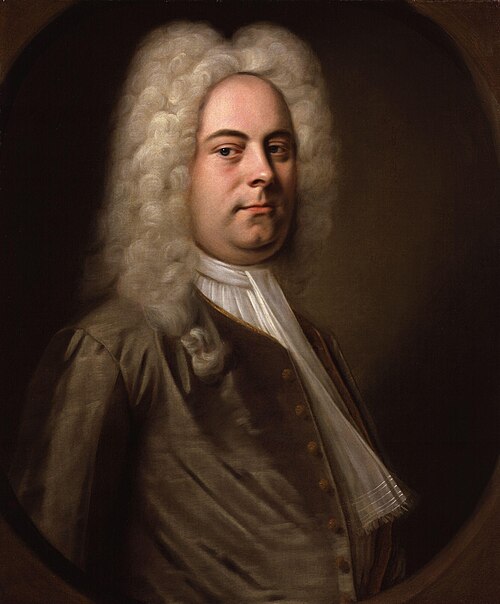
George Frideric Handel was many things to many people, but shrinking violet was not among those. It took abundant grit to do what he did, which was to go it alone in London’s rough-and-tumble theater world instead of taking the well-traveled path of a staff position in a court or church. He was one of the first major composers to work as a self-employed freelancer. Instead of patrons he had partners; instead of a congregation he had an audience. As composer, manager, producer, coGeorge Frideric Handel was many things to many people, but shrinking violet was not among those. It took abundant grit to do what he did, which was to go it alone in London’s rough-and-tumble theater world instead of taking the well-traveled path of a staff position in a court or church. He was one of the first major composers to work as a self-employed freelancer. Instead of patrons he had partners; instead of a congregation he had an audience. As composer, manager, producer, conductor, performer, and even stage director, Handel took the risks, reaped the profits when his shows were hits, and absorbed the losses when they flopped. Only the most incurable optimist would expect a smooth ride under such circumstances, and Handel was nothing if not a clear-eyed realist. He expected, and experienced, any number of boom-and-bust cycles.
He was at the ‘bust’ end of a cycle in 1735. For twenty years the English public had been flocking to Italian operas, but at long last tastes were changing. Handel’s potent fertility had sustained him in fine style since his 1711 hit Rinaldo had encouraged him to settle for good in England, and despite the slings and arrows that inevitably accompany theatrical enterprises, Handel had always made good with his London audiences. But now they were drifting away. Prefatory shivers of a coming tectonic shift had been felt as early as 1728, when Handel’s first Royal Academy had failed from a lethal combination of public ennui, shifts in royal favor, and the ruinous fees charged by superstar vocalists.
In 1729 Handel attempted a Second Academy. After a promising start the company began to falter, as ticket sales dwindled. The competing Opera of the Nobility began siphoning off some of Handel’s biggest draws, including his celebrity castrati Senesino and Carestini. Not one to give up without a fight, Handel countered with a steady stream of new operas, oratorios, orchestral works, and organ concertos with himself as soloist.
It didn’t work. By 1732 the Second Academy was struggling and the Opera of the Nobility was dissolved. Then Handel’s health deteriorated. In April 1737 he suffered from a nasty stroke that paralyzed his right arm and left him mentally impaired, at least for a while. Popular scuttlebutt had it that Handel’s career was all but over. But the naysayers had spoken too soon, and Handel soon arose from the hurly-burly of musical theater to a seat on musical Olympus.
The vehicle for that journey was already in Handel’s compositional bailiwick, although he did not know it at the time. He had written oratorios since his early years in Italy—Il Trionfo del Tempo e del Disinganno, La Resurrezione—and with his relocation to England he had made a tentative start with the Purcellian oratorio Esther of 1718–1720. His spectacular theatrical career quashed any further development along those lines, but the dicey state of his Second Academy led him to revive and expand Esther for the 1732 season. Esther established the pattern of Handelian oratorio to come—three acts characterized by a blend of liturgical-style choral music with the forms and idioms of Italian opera—and also brought a welcome respectability with its adoption of Biblical texts, a potent advantage in a London buzzing with theological debates and bombastic religious factions. So Esther was soon followed by Acis and Galatea (not technically an oratorio, but not an opera either), Deborah, and for the 1733 season, Athalia.
Handel was a stubborn man. Despite all the signs pointing to a bleak future for Italian opera, he remained determined to stay the course as long as possible, and thus Alexander’s Feast of 1736 stands as a bit of a sport between Athalia and the full bloom of Handelian oratorio with the twin 1738 masterpieces Saul and Israel in Egypt. Even the precise genre of Alexander’s Feast is tricky to determine. Not quite a full-scale oratorio, not quite a masque, its ambiguity is reflected in the title of John Dryden’s original poem “Alexander’s Feast; or, The Power of Musick: An Ode in Honour of St. Cecilia’s Day.” Handel was by no means the first composer to set the 1697 poem to music; one earlier version was by Restoration composer Jeremiah Clarke (c. 1674–1707), although the score itself is lost.
For his 1736 setting Handel worked with Irish-born librettist Newburgh Hamilton, who needed a career boost from the silly stage trifles that were his bread and butter. Despite his vow “not to take any unwarrantable Liberty” with Dryden’s original text, Hamilton nonetheless added a concluding chorus “Your voices tune” from his own The Power of Musick of 1720, thereby painting a target on his forehead for the barbs of later commentators. Other than that relatively minor misdemeanor, Hamilton merely divided Dryden’s poem into recitatives, arias, and choruses. Handel was apparently satisfied with the libretto; not only did he bequeath Hamilton £100 in his will for having “assisted me in adjusting words for some of my compositions” but he also renewed the collaboration with Samson in 1742, The Occasional Oratorio in 1745, and possibly 1744’s Semele.
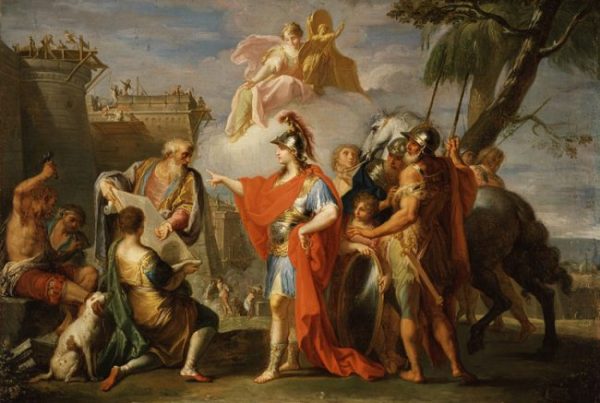
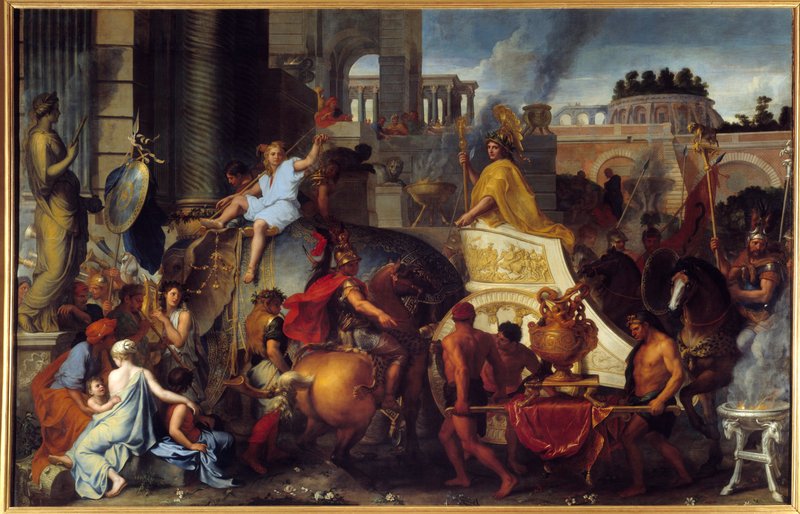
The Dryden-Hamilton libretto tells of a banquet held in about 330 BCE by Alexander the Great to celebrate his conquest of Persia. Together with his mistress Thaïs and his courtiers, Alexander is entertained by the musician Timotheus, whose music charms and saddens him, reminds him of lost loves, and at last incites him to set fire to the captured Persepolis in revenge for the slaughter of Greeks in earlier Persian wars.
Alexander’s Feast was an immediate and long-lasting success. The premiere on February 19, 1736 brought in a box office of £450—roughly equivalent to $175,000 today. Between 1737 and 1743 it was performed 18 times, and eight times more during the 1750s. However, it’s just a bit too short to provide a full evening’s entertainment, so from the first performances Handel bulked up the running time with substantial instrumental works, including concertos for harp and organ, a concerto grosso for the full orchestra, and even a brief cantata. Such interpolations and additions have been traditional in performances of Feast ever since.
Not all of the early performances were in London. Handel’s trip to Dublin for the 1741-42 season is legendary for the premiere of Messiah; what’s often overlooked is that he gave the Dubliners a newly revised version of Alexander’s Feast for concerts in February and March of 1742. As always, he had to work fast. The cantankerous Dean of St Patrick’s Cathedral, Jonathan Swift, absolutely forbade any of his choristers to do anything so lowly as sing in a public theater. So Handel had to scour Dublin for the best available singers, and he reworked the soprano, tenor, and bass solo parts for what he was able to drum up. The list included Susannah Cibber, a popular singing actress who was residing in Dublin to escape the vicious London press coverage of a lawsuit brought by her husband for adultery. For Alexander’s Feast Handel rewrote substantial soprano passages, including two arias, to suit her small but sweetly expressive contralto voice. A few weeks later Cibber achieved her moment of musical immortality when she sang in the world premiere of Messiah on April 13. Her rendition of “He was despised and rejected of men” was so luminous that it is said to have elicited a cry of “Woman, for this be all thy sins forgiven!” from the Reverend Patrick Delany, chancellor of Christ Church Cathedral.
Handel also added a brief third act to a text by Hamilton. The resultant ‘Dublin Version’ of Alexander’s Feast has received short shrift down the years; in fact, it has come very close to disappearing altogether. Music Director Peter Whelan has worked with Handel scholar Donald Burrows to reconstruct the Dublin score, which now receives its U.S. premiere, 284 years after its original performances.
Alexander’s Feast has never been a Handel evergreen like Messiah or Judas Maccabaeus. Outings have been relatively few. About 14 recordings are currently available, for example, compared to about 60 for Judas and 200-ish for Messiah. And of course the Dublin version is as yet more or less unknown. But Alexander’s modest presence does not translate into modest effectiveness. Just the vivid orchestration alone is worth exploring; consider the ghosts of slain Greek warriors suggested by a trio of bassoons, paired violas and cellos, and bass in “Revenge, Timotheus cries” or the gradual accumulation of instruments that lead into the mighty chorus “Break his bands of sleep asunder” with its spectacular trumpet effects. Nor is it formally predictable; Handel dispensed with da capo arias for the most part, and even provided an unusually high percentage of accompanied recitatives.
Preview the Music
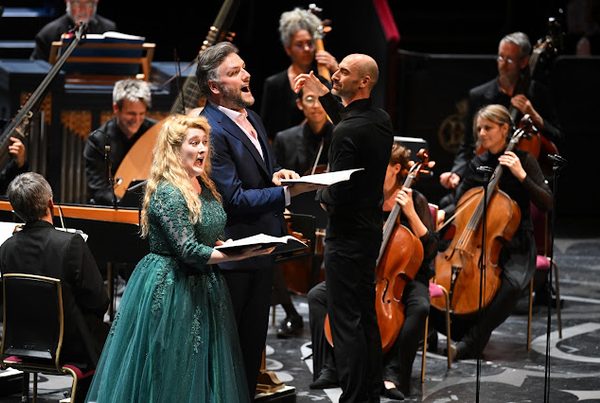
Music Director Peter Whelan leads the first U.S. performances of Handel’s 1742 Dublin version of Alexander’s Feast in Handel’s The Power of Music, performed on period instruments and in the style of the time. The concerts feature soprano Sherezade Panthaki, mezzo-soprano Rachael Wilson, tenor James Way, Philharmonia Baroque Orchestra, and Philharmonia Chorale under the direction of Valérie Sainte-Agathe.
Program
George Frideric HANDEL — Alexander’s Feast, or The Power of Music (1742 Dublin Version) (U.S. PREMIERE)
Peter Whelan, conductor
Sherezade Panthaki, soprano
Rachael Wilson, mezzo-soprano
James Way, tenor
Philharmonia Chorale, directed by Valérie Sainte-Agathe
Performances
Wednesday, November 11, 2026 • 7:30 PM
Bing Concert Hall
327 Lasuen St., Stanford, CA 94305
This program is co-presented as part of Stanford Live’s 2026/27 season.
Friday, November 13, 2026 • 7:30 PM
Herbst Theatre
401 Van Ness Ave, San Francisco, CA 94102
Saturday, November 14, 2026 • 7:30 PM
First Congregational Church of Berkeley
2345 Channing Way, Berkeley, CA 94704
Tickets
Tickets start at $40, and three-concert subscriptions start at $96. For tickets or information, call (415) 295-1900 (Mon-Fri, 10 AM-4 PM) or visit philharmonia.org/power.
Scott Foglesong is the award-winning Chair of Music Theory at San Francisco Conservatory of Music. He also writes program notes for San Francisco Symphony, California Symphony, Las Vegas Philharmonic, New Hampshire Music Festival, and Left Coast Ensemble.