
By Scott Foglesong
George Frideric Handel (1685–1759): Dixit Dominus, HWV 232 (1707)
Jean-Philippe Rameau (1683–1764): La Guirlande (1751)
Baroque Garlands: Preview the Music
George Frideric Handel (1685–1759)
Dixit Dominus, HWV 232 (1707)
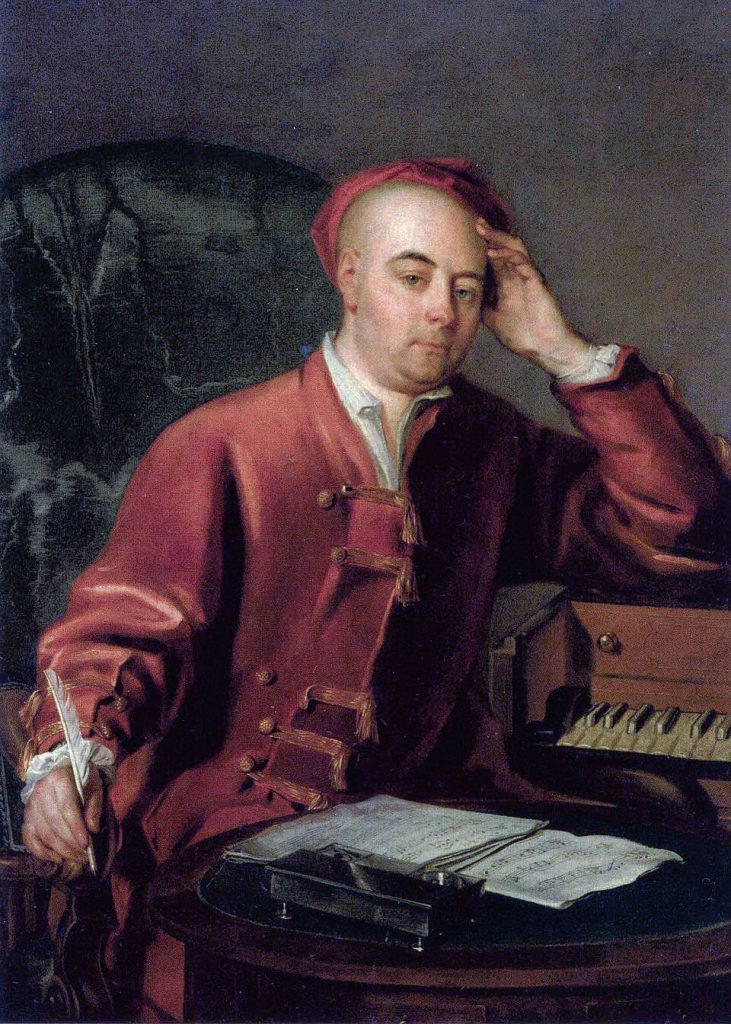
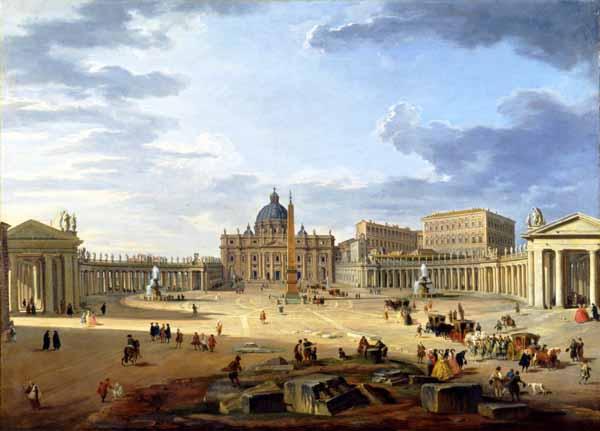
In late 1706 Handel arrived in Rome stifled under a prohibition, not against booze, but opera – then as now Italy’s national pastime. It came about because opera composers and producers had long recognized what theater folk have always known, which is that sex sells, and Vatican bigwigs had done what prissy bluestockings have always done, which is to have kittens about it. In a fit of moral pique the Vatican closed Rome’s opera houses, intending to be done once and for all with all that lurid licentiousness.
But no papal edict was going to keep Romans from their regular doses of musical theater. Rather than disappearing, opera went into hiding, barely disguised as startlingly vivid oratorios, cantatas, and the like, performed in the palaces of the well-heeled and influential. This was the state of affairs when Handel arrived for an extended stay, having been urged to journey south by Prince Ferdinand de’ Medici. He was soon employed by Rome’s leading musical power brokers – Cardinals Pamphili, Ottoboni, and Colonna, together with a rich layman, the Marquis Francesco Ruspoli. They were all no doubt fascinated by sheer potency of the young Saxon’s talent, his diamond-in-the-rough virility that brought lusty new life to the sophisticated but sometimes twee elegance of Italian music. For his part, Handel absorbed Italian musical idioms with unquenchable enthusiasm, and in the process matured from a gifted but slightly uncouth composer into a polished master. Handel’s four years in Italy were beneficial to all concerned: Handel underwent a priceless coming of age, and the Italians got a lavish banquet of terrific music.
But no papal edict was going to keep Romans from their regular doses of musical theater. Rather than disappearing, opera went into hiding, barely disguised as startlingly vivid oratorios, cantatas, and the like, performed in the palaces of the well-heeled and influential. This was the state of affairs when Handel arrived for an extended stay, having been urged to journey south by Prince Ferdinand de’ Medici. He was soon employed by Rome’s leading musical power brokers – Cardinals Pamphili, Ottoboni, and Colonna, together with a rich layman, the Marquis Francesco Ruspoli. They were all no doubt fascinated by sheer potency of the young Saxon’s talent, his diamond-in-the-rough virility that brought lusty new life to the sophisticated but sometimes twee elegance of Italian music. For his part, Handel absorbed Italian musical idioms with unquenchable enthusiasm, and in the process matured from a gifted but slightly uncouth composer into a polished master. Handel’s four years in Italy were beneficial to all concerned: Handel underwent a priceless coming of age, and the Italians got a lavish banquet of terrific music.
Which brings us to the Dixit Dominus. Precisely who asked for it, and who paid for it, isn’t known. Ruspoli is the most likely candidate. It’s music of extremes, of unapologetic and unabashed excess, theatrical as all get-out. Handel, well aware of the lofty reputation enjoyed by Italian choirs, seems to have written the work as a challenge to their excellence: Oh, you think you’re so great? Just try and sing THIS! The requirement is for five vocal soloists (SSATB), five-part chorus, and the usual body of strings plus continuo. All of them had better be good. Otherwise they won’t stand a chance with such frankly virtuosic and challenging writing. But Handel didn’t need to worry about that. Rome’s opera houses might have gone dark, but all those turbocharged singers and choruses were still very much on hand, primed and ready to thrill their aristocratic patrons in their glittering salons.
Dixit Dominus translates as “the Lord said,” and what he has to say isn’t even remotely pleasant. This isn’t some nice-guy deity, but rather the stern patriarch of the Old Testament, all too capable and willing to obliterate all who cross him. “He shall judge the nations, fill the places with destruction, and shatter the skulls in the land of the many,” fulminates Judicabit in nationibus. Handel matches all that bellicosity with broad leaps, etched rhythms, minor-mode harmonies, and even passages of downright dissonance over the span of the work’s eight movements. Consider the three-part Dominus a dextris tuis with its layered vocal parts that give way to the Conquassabit capita, all percussive repetitions of individual syllables, a technique originated by Monteverdi as a way of conveying martial energy and excitement. There’s the sturdy athleticism of Donec ponam, which contrasts a cantus-firmus figure with propulsive rhythms that might remind listeners of the “Hallelujah Chorus,” still a good 35 years in the future.
Of course it’s not all blood and guts. The alto aria Virgam virtuis could have stepped out of a Bach cantata, its delicate filigree passed between soloist and continuo. Sweetly consoling passages are definitely on order, such as the lovely De torrente in via bibet, although its suavity is acidified by frequent sliding dissonances between the two soprano soloists.
The final Gloria Patri is sectioned into two parts, the first of which tasks each section of the chorus with long florid runs that lead us to wonder when and how they’re supposed to breathe. Then comes the concluding Et in secula seculorum, a blistering contrapuntal tour de force that gives us Handel at his brawniest, its chiselled repeated-note fugue subject interleavened with vaulting sequences. Just when we think Handel has surely extracted everything possible from his materials, he reveals nervy new feats of imagination. Handel went on to write many a spectacular chorus over his long career, but in many ways he never topped this early adventure in derring-do, a swashbuckling gallop to the finish line guaranteed to leave everybody – performers and audience alike – thrilled, chilled, and breathless.
Jean-Philippe Rameau (1683–1764)
La Guirlande (1751)
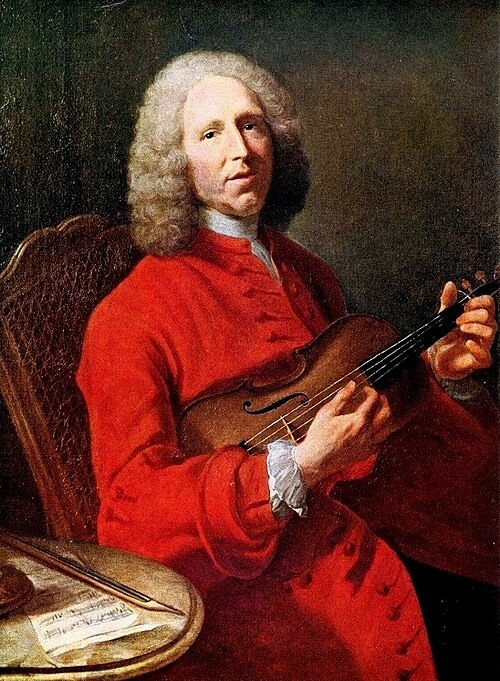
We of the musical commentariat must contend with a persistent problem where Jean-Philippe Rameau is concerned. It has nothing to do with his place in the scheme of things, which is well-established and widely acknowledged. He is not only a giant of French music but also a major figure in the evolution of modern music theory. His Treatise on Harmony is a foundational text to the discipline and can be consulted profitably to this day.
The problem lies with Rameau himself. Was he actually the creep he was made out to be, or was he misjudged by his contemporaries? The surviving evidence – and it’s quite paltry on the whole – points towards the latter. For one thing, the ingrown Parisians who dominated French music during the ancien régime discounted Rameau as a provincial bumpkin who grew up in Dijon, way out there in Burgundy and nowhere near Paris where all the cool people were. And then there was Rameau’s lack of couture. He wore the same ratty old clothes year-in, year-out. Nor was he any good when it came to courtly manners and repartee; he tended to be blunt. “Rameau was by nature harsh and unsociable; any feeling of humanity was foreign to him” sniped Melchior Grimm, adding that “his dominant passion was avarice.” Another wit opined that when Rameau finished playing his harpsichord and closed the lid, there was nothing else there.
It’s worth keeping in mind that Rameau spent the first half of his career working as an organist in poorly-paid gigs out in the middle of nowhere. He never quite starved, but this was somebody who knew the sharp bite of poverty. He was middle aged before he started making a halfway decent income, and by then penny-pinching was practically embedded in his DNA. He had a family to support, four children and his wife Marie-Louise, a singer whom he married when he was 42 and she was 19. So even if he could afford stylish clothes and all the accoutrements of gracious French society, he had no more truck with foppery than he had with the glitterati’s effete confabs. Furthermore, he was shy, modest, and frequently generous to his extended family. All in all, he comes across as more Harry Truman than Ebenezer Scrooge.
Rameau’s La Guirlande dates from his later career, after he had made his name with his lavish operas. (He was 68 when he wrote it.) It’s an acte de ballet – a one-act combination of opera and ballet, with the emphasis on dance. His librettist Jean-François Marmontel aimed to give him something better than the usual drivel, and to that end came up with a lightweight pastoral plot that offers abundant opportunities for singing and dancing. It’s a charming enough story, although there’s not much to it. A shepherd Myrtil and his lady love, the shepherdess Zélide, have exchanged enchanted flower garlands (guirlandes) that fade if one is unfaithful to the other. Of course Myrtil is unfaithful, so of course his garland fades, so of course the loving Zélide exchanges her unfaded garland for his. Mild mayhem ensues. But of course true love wins out in the end and everybody goes home happy.
La Guirlande holds the special distinction of being among the first Rameau works to be revived in modern times. When Claude Debussy heard the 1903 Paris performance, he declared: “Long live Rameau; down with Gluck.” (Debussy had a penchant for hyperbole.) No doubt he was reacting to Rameau’s skillful blend of lovely arias with robust dance music, the whole stitched together with imaginative orchestrations that were miles ahead of anything else at the time.
Among the high points we find an extraordinary aria (‘Tout languit dans nos bois’) that combines heartfelt sincerity with lavish surface ornamentation. Some of the dances impress with their striking instrumental sonorities, such as a Musette that captures the rustic sound of a shepherd’s bagpipes with uncanny accuracy. Several appropriately rambunctious Tambourins (a ‘tambour’ is a drum) enliven the generally peaceful surroundings, as do some delightful numbers involving the full chorus. In sum, La Guirlande is a minor but glittering jewel of Baroque theater, a fragrant evocation of that Never-Never Land of the Arcadian pastorale, and a superb specimen of Rameau’s refined late art.
Preview the Music
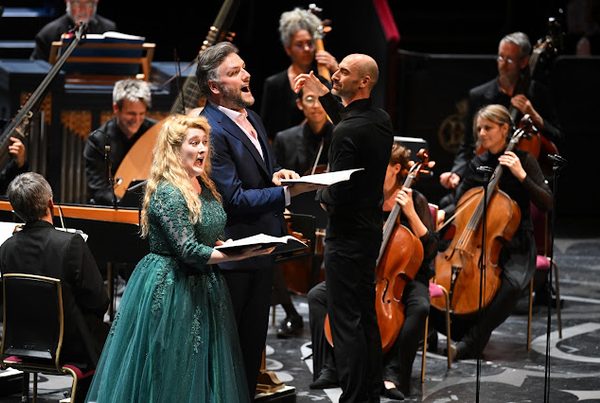
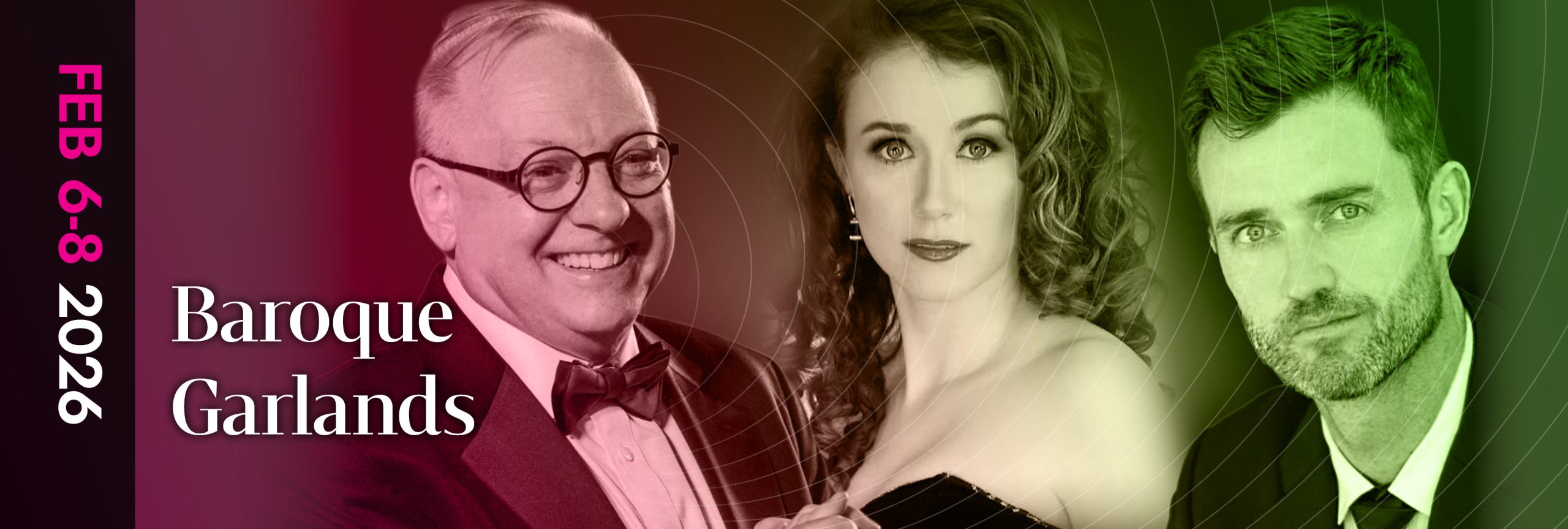
Hear Handel’s powerful Dixit Dominus paired with Rameau’s La Guirlande—French dance rhythms, operatic arias, and a lighthearted tale of romance nearly undone by a bewitched garland—in Baroque Garlands. One of the world’s foremost interpreters of 18th-century repertoire, Philharmonia’s longtime former Music Director Nicholas McGegan returns to conduct from the harpsichord. Performed on period instruments and with Philharmonia’s acclaimed Chorale, you’ll hear the music just as its first audiences did.
- Friday, February 6, 2026 – 7:30 PM | Herbst Theatre, San Francisco
- Saturday, February 7, 2026 – 2:30 PM | First Congregational Church, Berkeley
- Sunday, February 8, 2026 – 1:00 PM | Bing Concert Hall, Stanford
Tickets: $40 to $135 | $20 tickets available for Under 30s in SF & Berkeley. Save more with a subscription—as low as $84 for 3 concerts. Get tickets online or call the Box Office at (415) 295 2111.
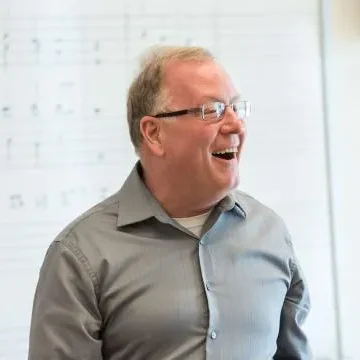
Scott Foglesong is the award-winning Chair of Music Theory at San Francisco Conservatory of Music. He also writes program notes for San Francisco Symphony, California Symphony, Las Vegas Philharmonic, New Hampshire Music Festival, and Left Coast Ensemble.