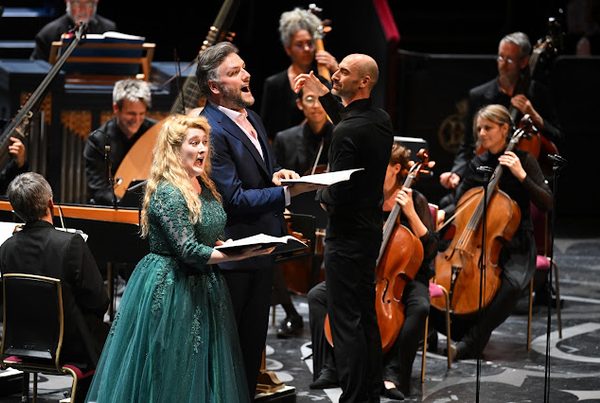

All the music you’ll hear today is performed on period instruments using historically informed performance practice, offering a listening experience close to what audiences might have heard in 18th-century salons and coffeehouses. Enjoy the music—and your coffee!
☕ Your Bite-Sized Program Notes
Georg Philipp Telemann – Trio Sonata in D major, TWV 42:D5
This trio sonata was composed during Telemann’s later years in Hamburg, where he worked as music director for more than 40 years. Written for two flutes and continuo, this sonata is often performed by two violins or flute and violin as we have this morning. The work illustrates his brilliant use of counterpoint, where distinct musical lines or melodies are played at the same time.
George Frideric Handel – Trio Sonata in B minor, HWV 386b
Handel combined German structural traditions with the melodic sensibility of Italian music. In this work, the treble instruments and continuo (the rhythm section in a Baroque band) are closely integrated, and the continuo also gets to play some melodic elements. It’s an example of Handel’s early writing for ensembles.
Johann Sebastian Bach – Sonata for Viola da Gamba and Harpsichord No. 2 in D major, BWV 1028 (excerpt)
Bach was a central figure of the Baroque period and known for his masterful use of counterpoint. Rather than casting the harpsichord in an accompanying role, this music elevates it to be an equal voice, with a conversational flow between the viola da gamba and harpsichord.
Jean-Féry Rebel – Two Musettes for Flute and Violin
Rebel was a French composer known for his approach to dance music and orchestration. These short pieces draw on pastoral elements, using drones and simple melodic lines. They reflect the stylized folk influences often heard in French court music of the early 1700s.
Georg Philipp Telemann – “Paris” Quartet in E minor, TWV 43:e4
Telemann often blended French, Italian, and German styles in his chamber works. Scored for flute, violin, viola da gamba, and continuo, this piece was written for a group of virtuoso musicians that Telemann met on a trip to Paris. The music is evenly balanced among the instruments and shaped by clear melodies and steady ensemble writing.
🎻 About Today’s Performers
Elizabeth Blumenstock – Violin
Elizabeth Blumenstock started playing the violin at age eight when her mother developed a crush on a fine local violinist. Their relationship did not pan out, but Elizabeth is still with the violin, despite brief affairs with some violas. She performs orchestrally as a leader with Philharmonia Baroque, Ars Lyrica Houston, American Bach Soloists, the Göttingen international Handel Festival, is Artistic Director of the Baroque Music Festival Corona del Mar, and plays chamber music with Santa Fe’s Severall Friends and Boston’s Sarasa, among several others.
Stephen Schultz – Flute
Stephen Schultz, called “among the most flawless artists on the Baroque flute” by the San Jose Mercury News and “flute extraordinaire” by the New Jersey Star-Ledger, plays solo and Principal flute with Philharmonia Baroque Orchestra, Musica Angelica, the Carmel Bach Festival, and Bach Collegium San Diego. He has also performed with other leading Early music groups such as Tafelmusik Baroque Orchestra, Apollo’s Fire, Portland Baroque Orchestra, Wiener Akademie, Chatham Baroque, Cantata Collective, and at the Oregon Bach Festival.
Elisabeth Reed – Viola da gamba
Elisabeth Reed teaches Baroque cello and viola da gamba at the University of California at Berkeley and at the San Francisco Conservatory of Music, where she is co-director of the Baroque Ensemble. Recent highlights include master classes at the Juilliard School, the Shanghai Conservatory and Middle School, and the Royal Academy of Music. Elisabeth also directs the “Voice of the Viol”, the renaissance viola da gamba ensemble of Voices of Music.
Corey Jamason – Harpsichord
Corey’s musical journey began as a piano student who was fascinated from a young age with playing Bach. While an undergraduate student he was introduced to the harpsichord, beginning a life-long obsession with the instrument and its repertoire. He has performed with a great variety of ensembles throughout the country and is the director of the Historical Performance program at the San Francisco Conservatory, where he has taught since 2001.
Please Join Us Again
If you enjoyed today’s performance, please join us again for the final free Coffee Concert of the summer, on September 16, at the earlier time of 10 AM to 11 AM. You’ll hear a fresh selection of Baroque and Classical works performed in the spirit of 18th-century salon concerts—and there will be more free coffee and pastries!
Philharmonia Baroque Orchestra & Chorale is one of America’s leading early music ensembles, performing on period instruments and faithful replicas modeled after those used from the 17th to 19th centuries. The full orchestra—often joined by the Philharmonia Chorale—performs across the Bay Area at Herbst Theatre (SF), First Congregational Church (Berkeley), and on the Peninsula at Mountain View Center for the Performing Arts, Bing Concert Hall at Stanford, and First United Methodist Church in Palo Alto.
Explore the 2025/26 season at philharmonia.org. Tickets start at $40, or just $84 for a three-concert package. $20 tickets are available for students and patrons under 30.