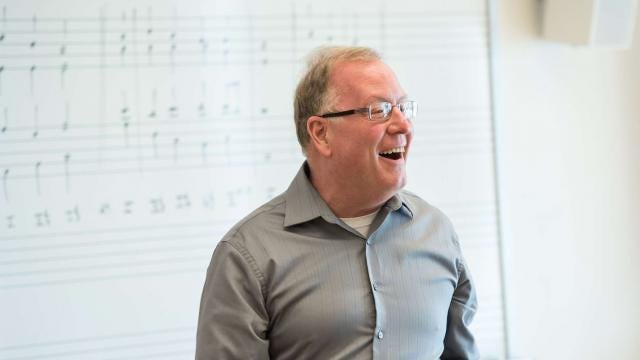
We’re thrilled to welcome back Scott Foglesong as our program notes annotator for the 2025/26 season. Scott’s connection with Philharmonia predates the orchestra itself—he was a student of our founder, Laurette Goldberg, and one of his early theory teachers was John Adams, before Adams became a famous composer. After more than a decade away, Scott returns to bring his trademark warmth, insight, and wit to our program notes.
What is your past history with Philharmonia?
I’m an old-timer who goes back before Philharmonia’s founding. As a master’s candidate at the San Francisco Conservatory of Music in the mid 1970s I double-majored in piano with Nathan Schwartz and harpsichord with Laurette Goldberg, soon to become Philharmonia’s founder. Not only was I her student for some years, but we wound up as very dear friends. I still miss her.
In 2010 Peter Pastreich became Philharmonia’s executive director after more than two decades at the San Francisco Symphony, where I was (and am) a Contributing Writer. Peter felt I would be the right person to bring a single unifying voice to Philharmonia’s program book, in those days a distinctly collective enterprise. I wrote two full seasons in that capacity and part of a third. I haven’t written for Philharmonia since 2013, so it’s a pleasure to be back!
Can you give us a few highlight reel moments from your long career in music?
With me, even a highlight reel is likely to run to Wagnerian lengths. Let’s see here: It all starts with the piano; I began playing at age 4. Eventually I got good enough to enter the Peabody Conservatory as an undergraduate. I went on to the San Francisco Conservatory of Music, where in addition to Nathan and Laurette, one of my theory teachers was John Adams – before he was a famous composer.
I was offered a position as a professor of musicianship (ear-training) and music theory at SFCM in 1977; I’m still doing that, which means that next year is my 50th anniversary! I taught music appreciation at UC Berkeley for almost 30 years; it was a connection at Cal that started me writing program notes and giving pre-concert lectures at the San Francisco Symphony from 2005 on. Writing has grown from a modest cottage industry to a full-fledged second career; nowadays I write for over a dozen organizations ranging from large to small. I also teach two courses a year at the Fromm Institute at USF.
Let’s put it this way: boredom is just not a problem for me. In fact, about the only thing I don’t have time for nowadays is playing the piano.
How do you approach writing Philharmonia’s program notes?
Writing for Philharmonia means that I’m not going to be rounding up the usual suspects. One of Philharmonia’s superpowers is its knack for visiting repertory that dwells off the beaten path, whether old, new, or in-between. Thus I need to do some extra homework. However, I’m not writing research papers here: it’s my privilege to guide listeners through each concert’s repertory and its composers, as one music lover to another.
And it’s also my privilege to be friendly and engaging about it. That’s a mindset that I bring to every program note I write, for all repertory, for all organizations. Writing program notes is first and foremost writing, after all. And I want to write as well as I can.