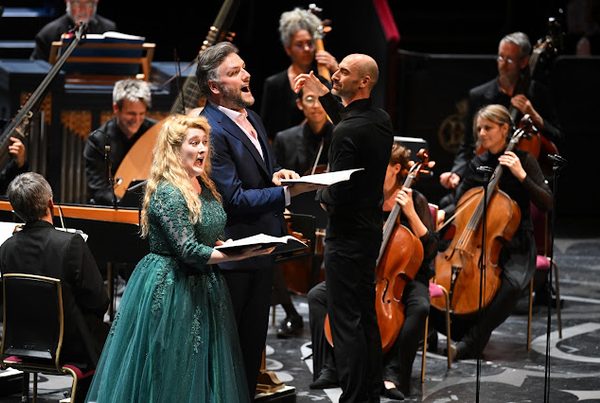
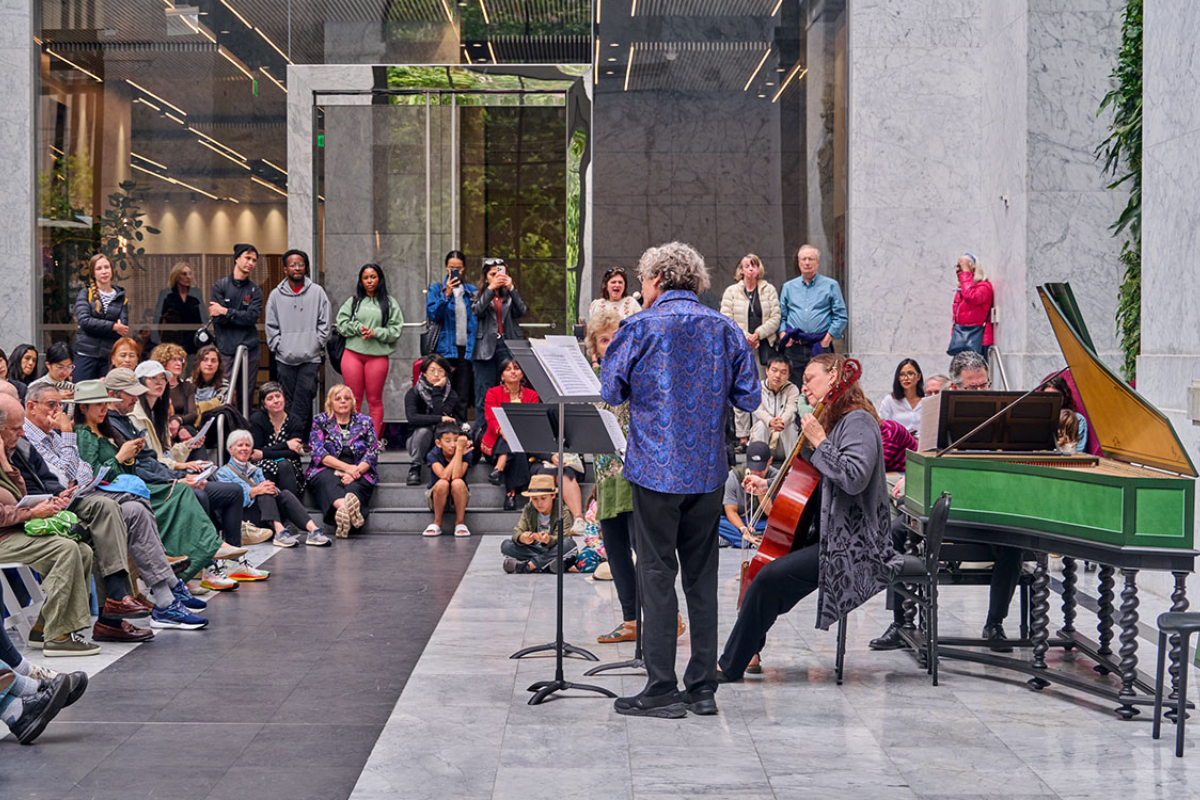
All the music you’ll hear today is performed on period instruments using historically informed practices, offering a listening experience close to what audiences might have heard in 18th-century salons and coffeehouses. Enjoy the music—and your coffee!
☕ Your Bite-Sized Program Notes
Johann Hermann Schein – Canzon à 6 in A minor
Schein served as musical director of the boys’ choir of St. Thomas Church in Leipzig, a job later held by J.S. Bach. His Canzon à 6, written for six parts, showcases his skill in counterpoint, where independent melodies are played together, and his lively, Italian-inspired rhythms.
Johann Schelle – Nun komm, der Heiden Heiland (instr.)
Schelle was an important German composer of the early Baroque, known for his church music and skillful instrumental writing. In this instrumental setting of the Advent hymn, the instruments take turns developing the tune, creating a flowing conversation. The piece combines the seriousness of the hymn with lively Baroque energy.
J.S. Bach – Ricercar à 6 from The Musical Offering
Bach composed The Musical Offering after a visit to the court of Frederick the Great, King of Prussia, using a theme given to him by the king. The Ricercar à 6 is a six-part fugue that showcases Bach’s extraordinary skill in weaving multiple independent lines into a single, cohesive piece of music. Each part enters in turn, creating a precise and intricate musical conversation.
C.P.E. Bach – Symphony in B minor, Wq. 182/5
Carl Philipp Emanuel Bach—second son of Johann Sebastian Bach—bridged two musical worlds. He moved away from the intricate, layered style of the Baroque and toward the bold, dramatic style of the early Classical era, often called “Sturm und Drang” (storm and stress).”
Clara Schumann – Prelude and Fugue in E minor
Clara Schumann was one of the foremost pianists and composers of the 19th century, admired for her musical skill and artistry. The Prelude and Fugue in E minor demonstrates her mastery of contrapuntal writing, where independent melodies are played together. The piece moves between quiet, introspective passages and more dramatic moments, highlighting her unique compositional voice.
Felix Mendelssohn – Octet in E-flat major, Op. 20, Finale
Mendelssohn composed this piece when he was just 16 years old, and it already shows remarkable maturity and inventiveness. The finale bursts with energy and playful exchanges between the eight instruments. Its lively rhythms and memorable themes bring the work to a joyful and exhilarating conclusion.
🎻 About Today’s Performers
Kati Kyme – Violin
Because her parents were both violinists, Katherine Kyme couldn’t wait to start the violin. She served as concertmaster of the orchestra at her three colleges, UCLA, UC Berkeley and Yale University, and continued in that role with American Bach Soloists, the Cantata Collective and Philharmonia. She loves playing quartets most of all, and she has played in the Sierra Quartet, the Artaria Quartet and, currently, the New Esterházy Quartet which specializes in the music of Haydn; the NEQ has performed Haydn’s 64 quartets twice. She plays a Testore violin from 1720.
Maxine Nemerovski – Violin
Violinist Maxine has performed across Europe, South America, and Brazil, appearing with ensembles ranging from Philharmonia Baroque Orchestra to the Jacksonville Symphony and even Led Zeppelin. She has created children’s concerts in Ireland, taught violin pedagogy in Nicaragua, and recorded for orchestral, film, commercial, and pop projects. An experienced educator, she has taught privately for over 30 years and served on the faculties of the Community Music Center, French American International School, and International High School. She plays on a violin by David Tecchler, Rome, Italy, 1733.
Noah Strick – Violin
Violinist Noah Strick performs regularly with a variety of ensembles throughout the Bay Area, including Philharmonia Baroque Orchestra, California Symphony, American Bach, Opera Parallèle, and West Edge Opera. His undergraduate studies took place at Oberlin Conservatory, where he studied modern violin with Kyung Sun Lee and baroque violin with Marilyn McDonald. He also holds a Master’s Degree and Professional Studies Diploma from SFCM, where he studied with Bettina Mussumeli. He plays on a modern violin made by John Newton in Toronto in 1997, modeled after a Guarneri del Gesu, and his baroque violin was made by Celia Bridges in Cologne in 1988.
Aaron Westman – Violin
Grammy-nominated violinist and violist Aaron Westman was a metal-head growing up in nearby Santa Rosa. He now plays the electric guitars of the 17th through 19th centuries (e.g. historical violin and viola). He completed his graduate work at the Indiana University Jacobs School of Music and began playing with Philharmonia shortly after moving back to California. Aaron co-founded and co-directs the chamber ensemble Agave, along with fellow Philharmonia musicians William Skeen, Kati Kyme, and Anna Washburn. Agave is a Grammy nominee, and they frequently collaborate with star singers Reginald Mobley, Cecilia Duarte, Michele Kennedy, and Kaleidoscope Vocal Ensemble. Aaron regularly plays principal viola with Philharmonia, Bach Collegium San Diego, Portland Baroque, and Harmonia Stellarum Houston, among many others.
Maria Caswell – Viola
Maria Caswell is a Sonoma County based performer and teacher on both violin and viola. She has specialized in the historically informed performance of baroque music. She is a founding member of Philharmonia Baroque Orchestra (1982-present), and a member of Voices of Music. In addition, she performs with Live Oak Baroque Orchestra in Sonoma County. When not fiddling, she likes to birdwatch, quilt, garden, and drink tea.
Anna Washburn – Viola
Anna Washburn grew up with folk roots in a vibrantly musical community in rural Maine, and began her career performing and teaching in Boston after studying with Peter Zazofsky at Boston University. In 2008, she completed her masters at the San Francisco Conservatory as a student of Bettina Mussumeli. After hearing Philharmonia Baroque play Beethoven’s 7th Symphony in a masterclass at the Conservatory, she knew she wanted to perform so passionately on gut strings, and has pursued that goal ever since. She performs and records with Philharmonia Baroque, Bach Collegium San Diego, Cantata Collective, Oregon Bach Festival, Tesserae (Los Angeles), and Live Oak Baroque Orchestra (Sonoma), as well as with opera companies Ars Minerva (San Francisco) and Opera Neo (San Diego) and the Mark Morris and Martha Graham Dance companies.
Laura Gaynon – Violoncello
In demand as a performer, educator, and presenter of cello and chamber music, Laura Gaynon performs both modern and baroque cello in concert halls across the United States, Europe, Canada, and China. Based in San Francisco, Laura has performed with the American Bach Soloists, the Oregon Bach Festival Orchestra, San Francisco Chamber Orchestra, Opera Parallele, Magik*Magik Orchestra, One Found Sound, and as a founding member of the baroque chamber ensemble MUSA.
William Skeen – Violoncello
William Skeen performs with Philharmonia Baroque Orchestra, Voices of Music, Agave, the Oregon Bach Festival, and the new Seattle Bach Festival. He co-founded the New Esterházy Quartet, Cantata Collective, and the SFEMS Classical Workshop. William taught baroque cello and viola da gamba at the University of Southern California for twenty years, and has appeared as continuo cellist with the Los Angeles Philharmonic, the Los Angeles Master Chorale, and San Diego Opera. When not playing (a rare occasion!), he enjoys crossword puzzles and studying Ital
Please Join Us Again
If you enjoyed today’s performance, please join us again at our upcoming concerts each featuring a fresh selection of Baroque and Classical works.
Philharmonia Baroque Orchestra & Chorale is one of America’s leading early music ensembles, performing on period instruments and faithful replicas modeled after those used from the 17th to 19th centuries. The full orchestra—often joined by the Philharmonia Chorale—performs across the Bay Area at Herbst Theatre (SF), First Congregational Church (Berkeley), and on the Peninsula at Mountain View Center for the Performing Arts, Bing Concert Hall at Stanford, and First United Methodist Church in Palo Alto.
Explore the 2025/26 season at philharmonia.org. Tickets start at $40, or just $84 for a three-concert package. $20 tickets are available for students and patrons under 30.