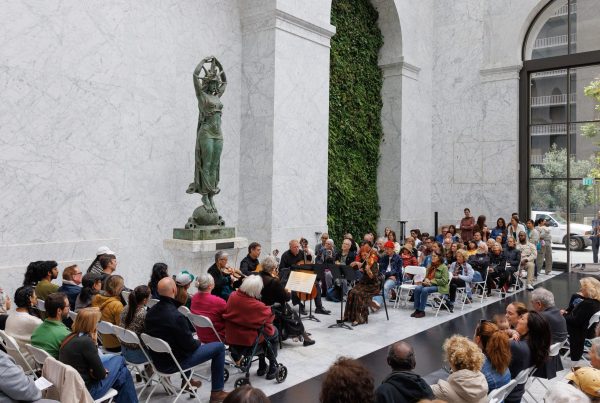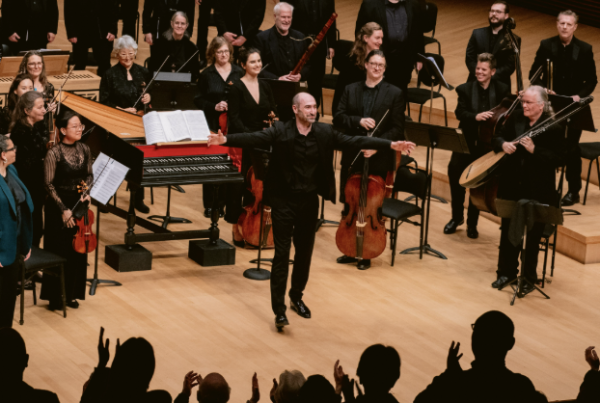
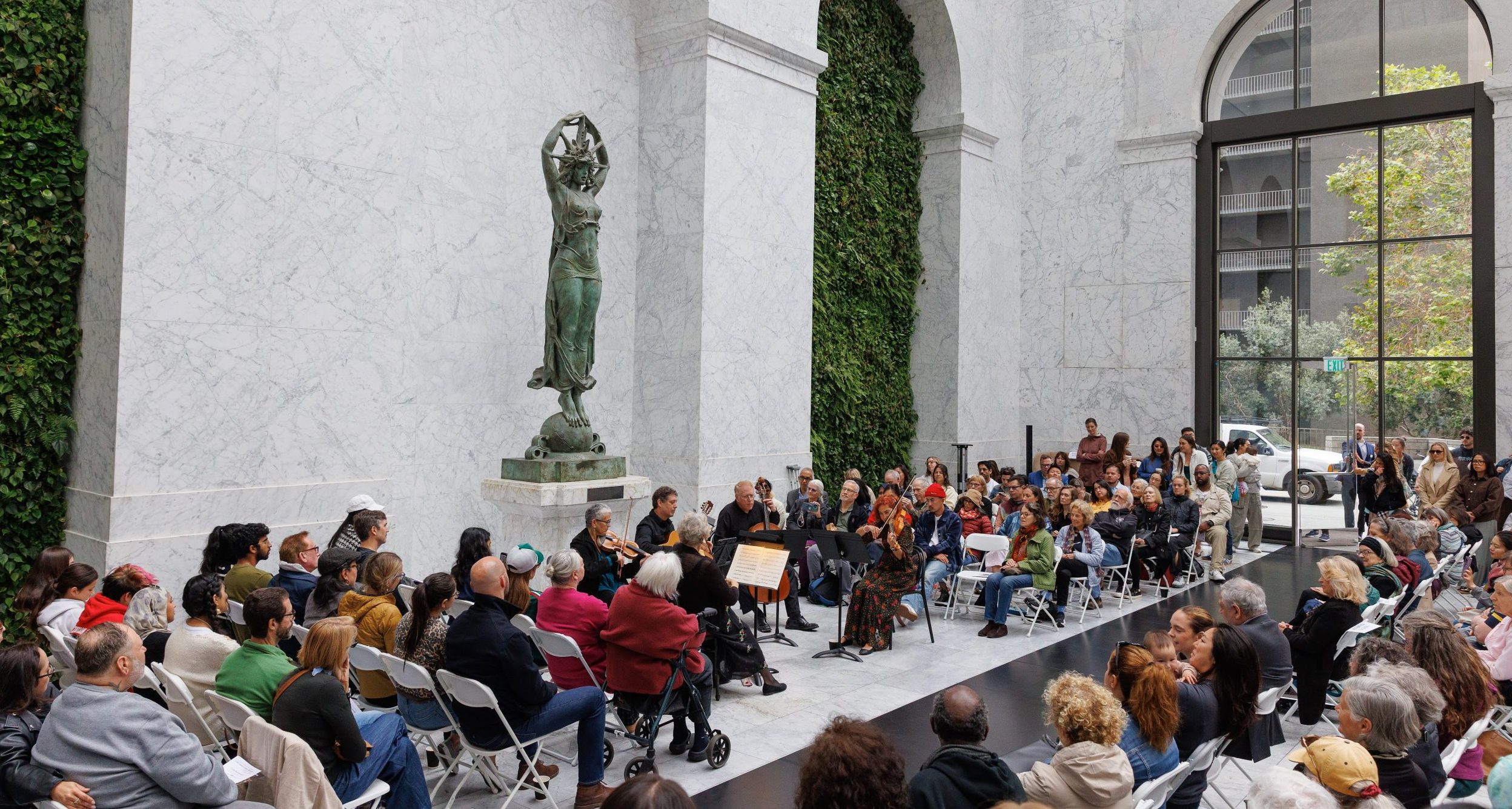
Our Coffee Concert series features members of Philharmonia Baroque Orchestra & Chorale performing on period instruments and in the style of the time, for a listening experience close to what audiences might have heard in the 18th-century salons and coffeehouses of Europe. Enjoy the music—and your coffee!
☕ Your Bite-Sized Program Notes
François Couperin – Sonade from “La Françoise” (Les Nations)
François Couperin (1668–1733) came from a dynasty of musicians so accomplished that he’s remembered simply as “Couperin le Grand” (“Couperin the Great”) to distinguish him from his equally musical relatives. He spent much of his career at the court of Louis XIV, serving as organist and harpsichordist to the Sun King himself.
“La Françoise” comes from Les Nations, a set of four ordres (suites) in which Couperin imagined how French and Italian musical styles might meet. The sonade — Couperin’s very French spelling of the Italian “sonata” — opens with Italy’s bold gestures and dramatic flair, translated into a distinctly French accent. It’s Couperin’s way of paying tribute to a foreign style while making it entirely his own.
François Couperin – Concert Royaux No. 1
The Concert Royaux were written for performances at Versailles, small chamber works meant to entertain Louis XIV during his private suppers. Despite the grand title, this is intimate music: courtly conversation in sound, full of refined ornamentation and quiet wit. It offers a glimpse into an evening at court, where music was simply part of the air the king breathed.
François Couperin – Dance Suite from “La Françoise” (Les Nations)
Where the sonade looked to Italy, the dance suite that follows brings the music back home. Couperin fills it with the elegant dance forms so beloved in France, each one a study in poise and grace. Hearing the two halves of “La Françoise” side by side is like watching a conversation between nations: Italian passion answered by French refinement, two musical languages finding common ground.
🎻 About Today’s Performers
Stephen Schultz – flute
Stephen Schultz, called “among the most flawless artists on the Baroque flute” by the San Jose Mercury News and “flute extraordinaire” by the New Jersey Star-Ledger, plays solo and Principal flute with the Philharmonia Baroque Orchestra and Musica Angelica, and performs with other leading Early music groups such as Tafelmusik Baroque Orchestra, Apollo’s Fire, Portland Baroque Orchestra, Wiener Akademie, and Chatham Baroque. Concert tours have taken him throughout Europe and North and South America, with featured appearances at the Musikverein in Vienna, Walt Disney Concert Hall, Royal Albert Hall, Concertgebouw, Teatro Colón, Carnegie Hall, and the Library of Congress.
A graduate of the Royal Conservatory of Music in Holland with additional degrees from CalArts and San Francisco State, Schultz is currently an Associate Teaching Professor in Music History and Flute at Carnegie Mellon University and director of the Carnegie Mellon Baroque Orchestra. He has also taught at the Juilliard School and the International Baroque Institute at Longy School of Music.
In 1986, Schultz founded the original-instrument ensemble American Baroque, bringing together some of America’s most accomplished baroque instrumentalists to define a new genre for historical instruments, pairing 18th-century music with newly commissioned works.
Schultz appears on over fifty recordings for labels including Dorian, Naxos, Harmonia Mundi USA, Centaur, NCA, and New Albion, and has produced and edited forty CDs for colleagues. He has also recorded with world music groups such as D’CuCKOO and Haunted By Waters, using an electronically processed Baroque flute to create sounds unique to his instrument. An active commissioner of new music, Schultz was the dedicatee of Carolyn Yarnell’s 10/18 (1998) for solo processed Baroque flute, and has premiered several works by Pittsburgh composer Nancy Galbraith, including Traverso Mistico (2006), Night Train (2008), Other Sun (2009), and Effervescent Air (2012).
Mindy Rosenfeld – flute
Fluent in the music of several eras, Mindy Rosenfeld is a founding member of the highly respected Baltimore Consort, with whom she tours extensively, and since 1989, of San Francisco’s Philharmonia Baroque Orchestra (“the nation’s premier early music ensemble”—New York Times), where she has performed under director Nicholas McGegan and guest conductors William Christie, Jordi Savall, Gustav Leonhardt, Andrew Parrott, Andrew Manze, Bernard Labadie and Trevor Pinnock; recorded extensively; and appeared in Lincoln Center’s Mostly Mozart Festival, the Berkeley Early Music Festival, BBC Proms (Royal Albert Hall), Concertgebouw (Amsterdam) and both Carnegie and Disney Halls.
Mindy is Principal Flutist and soloist with both the Symphony of the Redwoods (California) and the Mendocino Music Festival (California). As a guest artist, Mindy has performed with American Bach Soloists (San Francisco), Apollo’sFire (Cleveland), Musica Angelica (Los Angeles), San Diego Bach Collegium, Catacoustic (Cinncinnati), Portland’s Trinity Consort, Magnificat (San Francisco), the San Jose Symphonic Choir, San Francisco Bach Choir, Golden Gate Men’s Choir, Santa Rosa Symphony, Ukiah Symphony (as soloist), Modesto Symphony and numerous other Bay Area ensembles.
The mother of five boys, with a BA in Flute Performance from the Peabody Conservatory (Baltimore) and an MA in Modern and Baroque Flute Performance from San Francisco Conservatory, Mindy divides her time between performing, touring, teaching, dancing, her family, and their garden.
Elisabeth Reed – viola da gamba
Elisabeth Reed teaches Baroque cello and viola da gamba at the San Francisco Conservatory of Music, where she is co-director of the Baroque Orchestra. Her playing has been described in the press as, “intense, graceful, suffused with heat and vigor” and “Elisabeth Reed provided the authentic Baroque sound, with her delicately nuanced and powerful playing of the Baroque cello and viola da gamba.”
A member of the American Bach Soloists, Voices of Music, and Wildcat Viols, she has also appeared with the Seattle, Portland, and Philharmonia Baroque Orchestras, and at the Boston Early Music Festival, the Berkeley Early Music Festival, the Ohai Festival, the Whidbey Island Music Festival, and the San Luis Obispo Mozart Festival. A graduate of the North Carolina School of the Arts, the Oberlin Conservatory, the Eastman School of Music, and Indiana University’s Early Music Institute, she can be heard on the Virgin Classics, Focus, and Magnatune recording labels. She also teaches baroque cello and viola da gamba at the University of California at Berkeley.
Highlights of this current season include performances of Haydn trios with Ian Swensen and Ken Slowik at the Smithsonian Institution in Washington D.C.; 17th century German chamber music with Monica Huggett in Portland, OR; French Baroque chamber with Byron Schenkman and Ingrid Matthews and the St. John Passion with Steven Stubbs and Pacific Musicworks in Seattle, WA. She is a Guild-certified practitioner of the Feldenkrais Method of Awareness Through Movement, with a focus on working with musicians and performers.
Corey Jamason – harpsichord
Corey Jamason is a GRAMMY-nominated harpsichordist whose playing of Bach has been described in the Los Angeles Times as displaying “the careful, due balance of objective detachment and lofty passion.” The San Francisco Classical Voice also raved about his performance of the Chromatic Fantasy and Fugue as: “simply put, the best performance I’ve ever heard of this piece…his harpsichord touch was phenomenal, and those listeners who believe the instrument incapable of dynamic contrast could have received a sharp corrective from Jamason’s ebbs and tides in this fantasy.”
Jamason appears frequently with American Bach Soloists, with whom he is principal keyboardist and co-director of the ABS Academy held each summer at the Conservatory. He has performed with a variety of ensembles including the San Francisco Symphony, Los Angeles Opera, Cantata Collective, Philharmonia Baroque Orchestra, Musica Angelica, Yale Spectrum, Musica Pacifica, El Mundo, and Camerata Pacifica, for whom he directed a series of concerts for several years in southern California. Festival appearances include the Berkeley, Bloomington, San Luis Obispo Mozart, Music in the Vineyards, Whidbey Island, Tage Alter Musik Regensburg (Germany), Echi lontani (Sardinia) and Norfolk festivals.
Jamason is co-artistic director and conductor of Studio for the Early American Musical, a San Francisco-based ensemble specializing in musical comedy from Broadway and vaudeville from the first decades of the twentieth century. In 2007 he conducted performances of Monteverdi’s Orfeo at the Bloomington Early Music Festival in celebration of the 400th year anniversary of its premiere and from 2007 to 2014 was artistic director and conductor of the San Francisco Bach Choir. Recordings include performances with American Bach Soloists, Cantata Collective, violinist Gilles Apap, El Mundo, and recorder player Astrid Andersson. He is a contributing author to the History of Performance, published in 2012 by Cambridge University Press. Born in New York City, Jamason received degrees in music from SUNY-Purchase, Yale University, and the Early Music Institute at Indiana University where he received a D.M. degree. He joined the faculty of the San Francisco Conservatory in 2001, where he is professor of harpsichord and chair of the Historical Performance program.
Please Join Us Again
If you enjoyed today’s performance, please join us again at our upcoming concerts each featuring a fresh selection of Baroque and Classical works.
Philharmonia Baroque Orchestra & Chorale is one of America’s leading early music ensembles, performing on period instruments and faithful replicas modeled after those used from the 17th to 19th centuries. The full orchestra—often joined by the Philharmonia Chorale—performs across the Bay Area at Herbst Theatre (SF), First Congregational Church (Berkeley), and on the Peninsula at Bing Concert Hall at Stanford and First United Methodist Church in Palo Alto.
Explore the 2026/27 season at philharmonia.org. Tickets start at $40, or just $96 for a three-concert package. $20 tickets are available for students and patrons under 30.